How to assign different points for specific statements in a grid question?

"How can I use reverse-scored items?"- Google Docs Editors Community

Validated questionnaires reverse-score some statements so people read each one before answering. In the Oxford Happiness Questionnaire, 12 of the 29 statements are scored backwards: strongly agree earns 6 on most rows and 1 on those. 22 people on Google's forum have asked how to use reverse-scored items in Google Forms. A grid question treats every row the same, and a Google Forms quiz can't put points on its columns, so the scoring moves to a spreadsheet. With Formfacade, the GRIDSCORE function takes a list of rows and the points for each column, so you write one GRIDSCORE for the normal rows and one for the reversed rows. The score is worked out on the form and syncs to Google Sheets in its own column.

Let's start. Create your form and follow the steps below.

How to assign points using the GRIDSCORE function?

  • On the page that opens, name your form, click Create form and click Proceed.

The tabs Edit, Preview, Share and Responses, with Edit marked
  • In the Assign points dialog, AI score setup is picked under "How do you want to set up scoring?". Click Proceed.
  • "Describe how you want to score this form" is filled in. Click Send and click Next.
  • Click the × on "You're all set" to go back to the "Edit" tab.
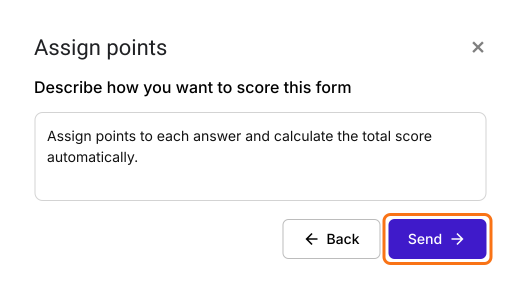
The Assign points dialog asking Describe how you want to score this form, with the box filled in and Send marked
Let's change this form into the Oxford Happiness Questionnaire to measure the current level of happiness. This happiness questionnaire consists of 29 statements. The items are a combination of positively and negatively phrased statements and pertain to different areas of well-being. This ensures that the respondent takes time to carefully read each item before answering. The survey asks you to evaluate each statement and rate it according to how much you disagree or agree with the statement. It uses a 6-point Likert scale with 6 being the highest as "strongly agree".
We will use a multiple choice grid question with 29 statements that pertain to different areas of well-being. The answer choices for this multiple choice grid question are as follows: strongly disagree, moderately disagree, slightly disagree, slightly agree, moderately agree, strongly agree. Please follow the instructions below to assign points and calculate the score.
  • Click on a question and change it to Multiple choice grid in the list of question types. Enter the statements under Rows and the answer choices under Columns. Delete the questions you do not need.
  • Your form already has a Score question, which may be named Total Score. Click on the score question, then click the ⚙️ icon.
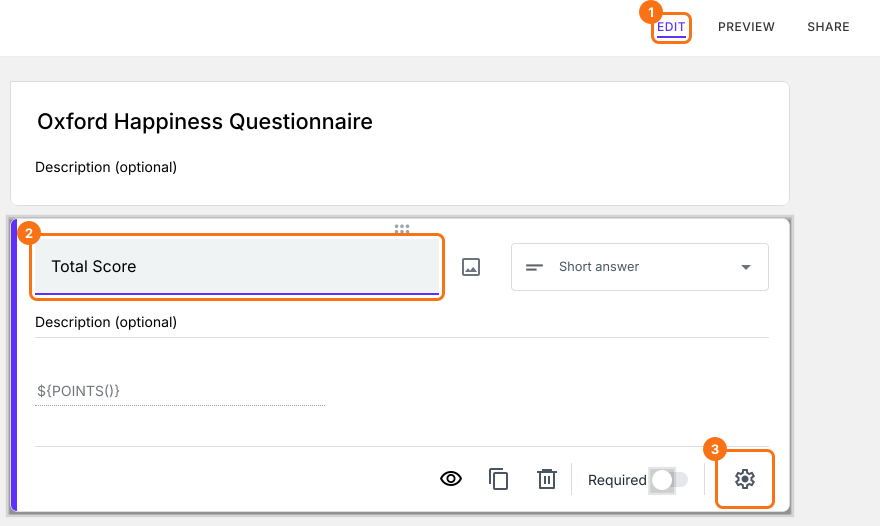
Oxford Happiness Questionnaire on the EDIT tab with the Total Score question selected and EDIT, the question and the gear at the bottom of its card marked
  • Select the "Answer" tab and write the formula to assign points and calculate the score.
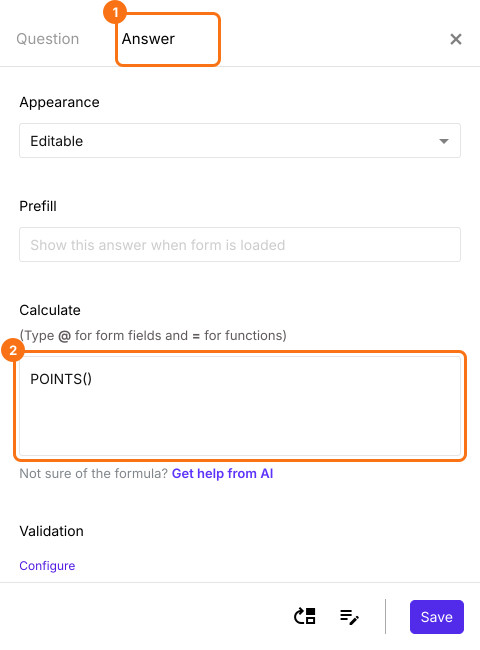
The Answer tab of the Score question with Answer and the Calculate box holding POINTS() marked

GRIDSCORE function

You can use the GRIDSCORE function to assign the points to the columns (answer choices) for specific rows (statements) in a grid question and calculate the score.
The happiness questionnaire has 29 statements in a multiple choice grid question with a 6-point likert scale. Twelve of the 29 items are scored reversely. The answer choices for statements 2, 3, 4, 7, 8, 9, 11, 12, 15, 16, 17, 18, 20, 21, 22, 25, 26 will be assigned the points as shown below.
  • strongly disagree = 1
  • moderately disagree = 2
  • slightly disagree = 3
  • slightly agree = 4
  • moderately agree = 5
  • strongly agree = 6
GRIDSCORE(entry#id, [2, 3, 4, 7, 8, 9, 11, 12, 15, 16, 17, 18, 20, 21, 22, 25, 26], 1, 2, 3, 4, 5, 6)
The answer choices for statements 1, 5, 6, 10, 13, 14, 19, 23, 24, 27, 28, 29 will be assigned the points as shown below.
  • strongly disagree = 6
  • moderately disagree = 5
  • slightly disagree = 4
  • slightly agree = 3
  • moderately agree = 2
  • strongly agree = 1
GRIDSCORE(entry#id, [1, 5, 6, 10, 13, 14, 19, 23, 24, 27, 28, 29], 6, 5, 4, 3, 2, 1)
Happiness score is the average of all the statements. The formula to calculate the happiness score is:
(GRIDSCORE(entry#id, [2, 3, 4, 7, 8, 9, 11, 12, 15, 16, 17, 18, 20, 21, 22, 25, 26], 1, 2, 3, 4, 5, 6) + GRIDSCORE(entry#id, [1, 5, 6, 10, 13, 14, 19, 23, 24, 27, 28, 29], 6, 5, 4, 3, 2, 1)) / 29
Note: Type @ and select the required multiple choice grid question from the list to add its entry #id in the above formula.
  • The Calculate option already has POINTS(). Delete it and write the GRIDSCORE function in the Calculate option as shown below and click Save. The lowest happiness score is 1 and the happiest score is 6. The average score is slightly above 4.
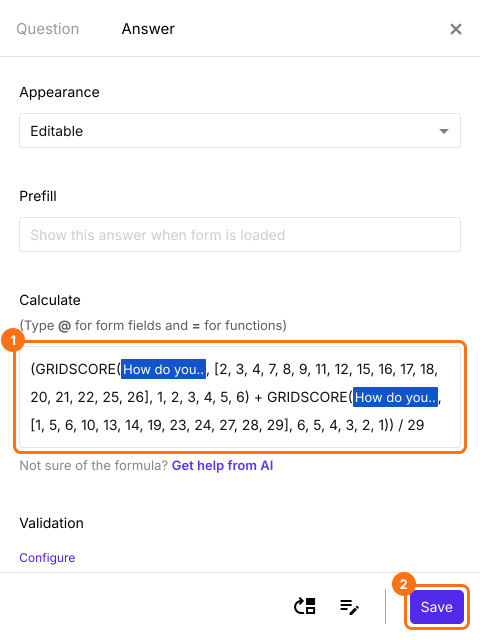
The Calculate box with the two GRIDSCORE functions added together and divided by 29 and the Save button marked
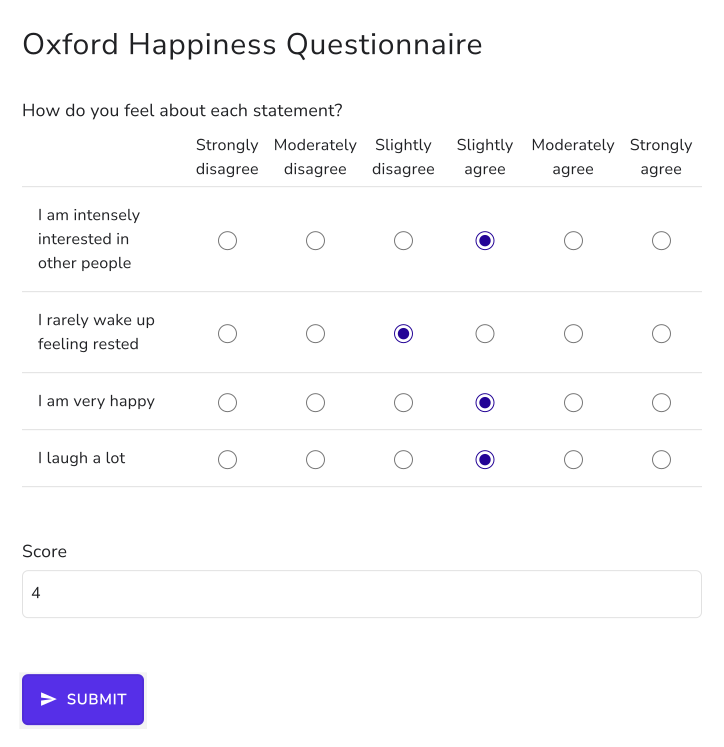
The score is calculated as users answer the question.
The Oxford Happiness Questionnaire as a multiple choice grid on a 6-point scale, answered, with a Score of 4

Summary

Google Forms scores every row of a grid the same way, so a questionnaire with reverse-scored statements has to be scored by hand. With Formfacade, you write GRIDSCORE for each group of rows with its own points and add them in the Score question. Create your form and complete the steps above. If you have any questions, write to support.

Last updated: